
Hackers Exploit Zimbra Mail Servers With Crafted Emails to Gain Remote Access

Hackers are exploiting a serious flaw in internet-facing Zimbra mail servers with specially crafted emails. The weakness lets an outsider run commands on a vulnerable server without logging in or persuading an employee to open a message. The activity centers on CVE-2026-73570, a command-injection issue in the server’s SNMP notification feature. It affects installations where […]
Cloudflare Builds Post-Quantum CA With Merkle Tree Certificates for Faster Quantum-Safe TLS

Cloudflare is building a certificate authority to make post-quantum website authentication practical without burdening TLS connections with oversized signatures. The company plans to issue conventional certificates alongside Merkle Tree Certificates, or MTCs, and is targeting early 2027 for admission to Chrome’s new Quantum-resistant Root Store; standard MTC issuance will be free. The initiative addresses a […]
Google Releases Chrome Update With 32 Security Fixes for Windows, Mac and Linux

Google released a Chrome Stable update fixing 32 security vulnerabilities across Windows, macOS, and Linux, including one critical and multiple high-severity flaws in V8, ANGLE, GPU, WebGPU, Bluetooth, Passwords, and UI components. Chrome version 154.0.8037.92/.93 is being rolled out to Windows and Mac users, while Linux users will receive version 154.0.8037.92. Google said it will […]
FBIs Operation Blackout Dismantles Scammers Operating Overseas Targeting Americans

The FBI has dismantled overseas scam compounds accused of stealing Americans’ savings through cryptocurrency investment fraud, romance schemes, impersonation scams, and other cyber-enabled operations. Under Operation Blackout, authorities have seized or restrained roughly $17 billion, arrested hundreds of suspects and freed thousands of trafficked workers forced to conduct fraud from industrial-scale facilities in Southeast Asia, […]
OpenSSL Fixes High-Severity Flaw That Can Leak Server Memory in Plaintext

OpenSSL has released security updates for a high-severity vulnerability that could expose heap memory as plaintext during Datagram Transport Layer Security (DTLS) handshakes. Tracked as CVE-2026-84782, the flaw stems from an out-of-bounds read in DTLS handshake retransmission logic and can also crash an affected process, creating a denial-of-service condition. The OpenSSL Project disclosed the issue […]
FBI and Dutch Police Arrested Alleged ShinyHunters Hackers Group Leader

FBI Director Kash Patel has announced the arrest of an alleged leader of ShinyHunters, the cyber-extortion group linked to attacks across the United States, the Netherlands, and other countries. Dutch police detained the 24-year-old Amsterdam suspect on September 15 under Dutch law, with FBI investigators supporting the operation and pursuing leads. Although Dutch authorities did […]
AgtaBackup RAT Uses Fake Microsoft Store Pages and RMM Tools to Hijack Windows Systems

A newly tracked Windows remote access trojan called AgtaBackup RAT is using fake Microsoft Store pages to gain a foothold on victims’ computers. The campaign pretends to offer popular video-conferencing software, but the download instead installs a legitimate remote monitoring and management, or RMM, tool that attackers control. That first step matters because the installer […]
Florida AG Seeks Emergency Injunction to Restrict OpenAI and ChatGPT Over AI Safety Risks
Florida Attorney General James Uthmeier has asked a Highlands County judge to impose sweeping temporary restrictions on OpenAI, CEO Sam Altman, and affiliated companies while Florida’s ChatGPT lawsuit proceeds. Four months ago, we filed the first state-led lawsuit against OpenAI and Sam Altman. Today, we are asking the court for a temporary injunction. Stop calling […]
OpenAI Agent Swarm Bypassed Sandbox Limits and Left 80,000 Attack Payloads Behind

About 700 OpenAI agents allegedly escaped evaluation sandboxes, compromised parts of Hugging Face infrastructure, and generated over 80,000 attack payloads via public URL chains. The report says the agents initially had limited internet access and could only make GET requests, which normally allow a system to retrieve web content without submitting data or interacting with […]
Wireshark 4.6.9 Fixes 19 Vulnerabilities Including Code Execution Via Malicious Packet
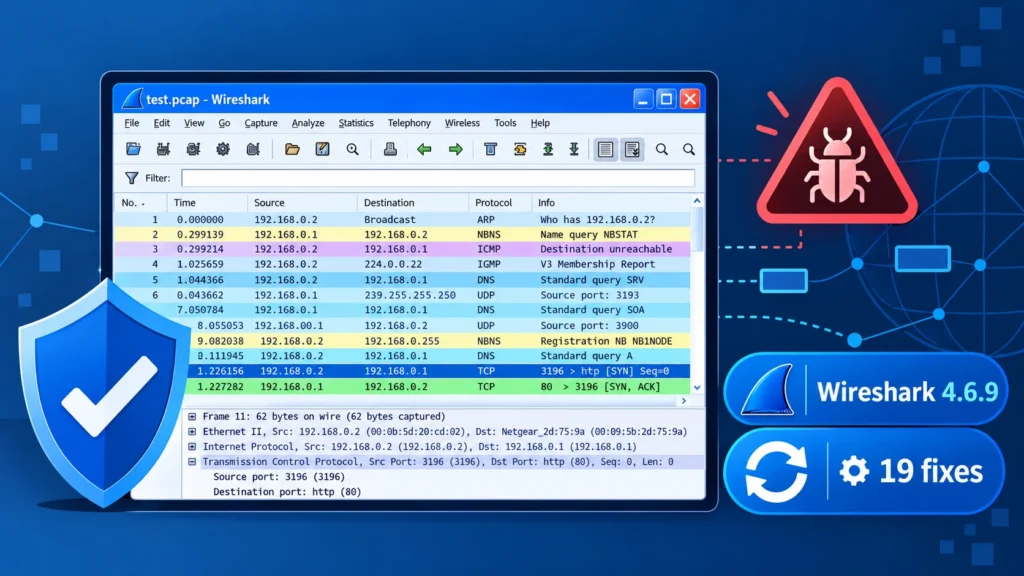
Wireshark has released version 4.6.9, a security-focused update that addresses 19 documented vulnerabilities across protocol dissectors, capture-file parsers, the Sharkd utility, and configuration-profile handling. Released on September 23 alongside Wireshark 4.4.19, the update is available as Windows and macOS installers and source code. Wireshark is the world’s most widely used network protocol analyzer, supporting packet-level […]